


Polyc Machine Wet Grinding Mill vs Traditional Mills: Key Performance Advantages

In the demanding environments of chemical processing, coatings manufacturing, and advanced material production, the choice of milling technology is a critical business decision. For decades, traditional mills like ball mills, three-roll mills, and older-generation bead mills have been the industry workhorses. However, the emergence of advanced wet grinding systems, such as those engineered by Polyc Machine, represents a significant technological leap. When placed side-by-side with their traditional counterparts, these modern mills demonstrate clear and compelling advantages in performance, reliability, and overall value, redefining what processors can expect from particle size reduction.
Unmatched Fineness and Superior Particle Uniformity
The most striking differentiator lies in the final product's quality. Traditional ball mills, which rely on tumbling action and impact, often struggle to achieve a narrow particle size distribution. The result can be a "tail" of larger particles that negatively impacts gloss, color strength, or reactivity. In contrast, the Polyc wet grinding mill is engineered for precision shearing and attrition, often using a tightly controlled bead media system. This focused mechanical action is exceptionally effective at breaking down agglomerates to their primary particles, reliably and consistently achieving sub-micron and even nano-scale fineness. The resulting particle size distribution is remarkably tight, which translates directly to enhanced performance in the final application, whether it's a deeper color saturation in ink or a smoother finish in automotive paint.
Drastic Reduction in Processing Time
Time is a direct cost in manufacturing, and here, the efficiency gap is substantial. A traditional ball mill might require extended processing cycles—sometimes 24 hours or more—to approach a target fineness, with effectiveness diminishing as viscosity changes. The high-energy density and intense shear forces generated within a modern Polyc mill accomplish superior dispersion in a fraction of the time. What takes a day in a ball mill can often be achieved in mere hours or even minutes with advanced wet grinding technology. This acceleration in processing speed allows for faster batch turnover, greater production flexibility, and the ability to respond more quickly to market demands.
Enhanced Energy Efficiency and Lower Operational Cost
The prolonged run times of traditional mills come with a significant energy penalty. They often operate with relatively low energy transfer efficiency, meaning much of the input power is dissipated as heat and noise rather than productive grinding work. Polyc mills are designed with efficiency as a core principle. Their optimized rotor-stator systems or agitated media chambers are engineered to maximize the transfer of mechanical energy directly to the slurry. This focused approach reduces the specific energy consumption—the kilowatt-hours required per kilogram of processed material. Over thousands of operating hours, this leads to substantial savings on electricity, directly improving the operating cost structure and environmental footprint of the production line.
Unprecedented Process Control and Repeatability
Traditional milling methods often involve a degree of art and estimation. Factors like mill charge volume, rotational speed, and even ambient temperature can lead to variable outcomes from one batch to the next. Modern Polyc technology brings a scientific level of control to the process. These systems can be equipped with precise temperature regulation (often via cooling jackets), accurate flow control pumps, and monitoring systems for parameters like pressure and motor load. This allows operators to define and lock in a perfect recipe for a given product. The result is exceptional batch-to-batch consistency, eliminating costly off-spec material and ensuring that every production run meets the exact same high standard.
Handling a Broader Range of Formulations with Ease
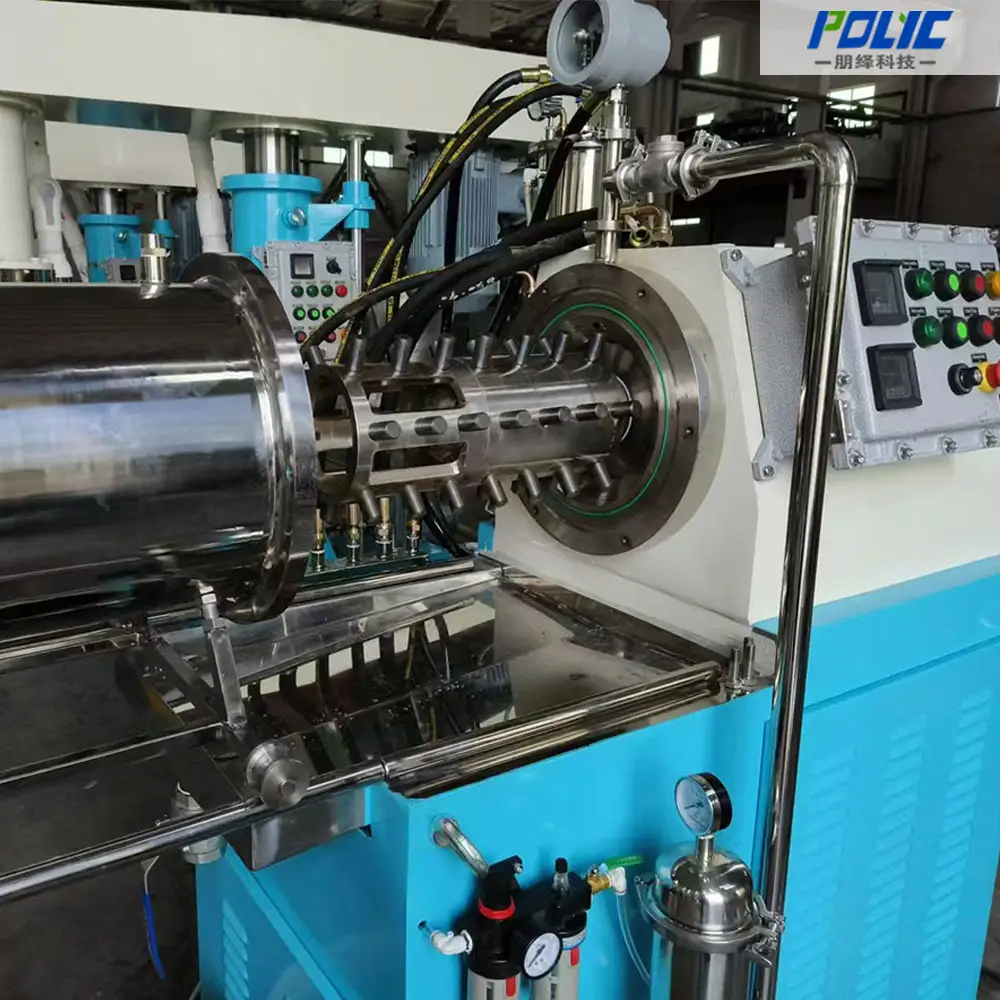
Traditional mills can be limited in their versatility. A three-roll mill, for instance, may struggle with low-viscosity products, while older bead mills might clog with high-solid-content pastes. The engineering behind Polyc wet grinding mills is focused on robust versatility. They are designed to handle a wide spectrum of viscosities, from thin solvent-based coatings to thick ceramic pastes. Advanced media separation systems, such as dynamic gap separators or screen cartridges, ensure reliable operation without blockages, even with challenging, abrasive, or high-solid-load formulations. This flexibility reduces the need for multiple, specialized milling platforms, allowing a single, well-chosen Polyc mill to service a diverse product portfolio.
Minimized Product Contamination and Simplified Maintenance
Material purity is paramount in many industries. Traditional mills, with their metal-on-metal contact and use of grinding media that can wear significantly, pose a tangible risk of metallic contamination. Polyc mills address this proactively. Critical wear parts and grinding media are available in a variety of ceramic materials (like yttria-stabilized zirconia) and specialized polymers that are extremely hard and chemically inert. This dramatically reduces the risk of product contamination. Furthermore, the modular and accessible design of these modern mills simplifies routine maintenance and cleaning, reducing downtime during product changeovers and ensuring the integrity of sensitive formulations.
Building a Clear Case for Modernization
While traditional mills have served industries well, the performance advantages of modern Polyc wet grinding systems are undeniable. They deliver a superior product in less time, using energy more intelligently, and with greater operational control. For businesses facing pressures to improve quality, boost throughput, and reduce costs, the transition from traditional to advanced wet grinding technology is not merely an equipment upgrade—it is a strategic modernization of a core process. This shift builds a foundation for greater competitiveness, enabling manufacturers to produce higher-value, more consistent materials that meet the exacting standards of today's and tomorrow's markets.

 English
 Arabic
 Spanish
 Portuguese
 Deutsch
 Turkish
 Dutch
Dutch
 Italiano
 Russian
 Romaian
 Portuguese (Brazil)
 Greek
Greek
