Full-stack development is integral to building comprehensive web applications, encompassing both front-end and back-end technologies. For those new to the field, grasping the fundamental concepts and essential tools is crucial for becoming a successful full-stack developer. This guide will walk you through these core elements to aid your journey into full-stack development.
If you want to excel in this career path, then it is recommended that you upgrade your skills and knowledge regularly with the latest Full Stack Developer Online Training.
Essential Concepts in Full-Stack Development
1. Front-End Development
The front end comprises everything users interact with directly in their browsers. Key technologies in this area include:
HTML (HyperText Markup Language): The foundation of web content, HTML structures web pages.
CSS (Cascading Style Sheets): Governs the styling and layout of web pages, controlling aspects like colors, fonts, and overall appearance.
JavaScript: This language adds interactivity to web pages, allowing for dynamic content updates and engaging user experiences.
Modern front-end frameworks like React, Angular, and Vue.js enhance JavaScript capabilities, enabling the creation of sophisticated user interfaces.
2. Back-End Development
The back end refers to the server-side of a web application, responsible for processing requests, managing databases, and executing business logic. Key components include:
Server: Hosts the application and manages incoming requests, often using technologies like Node.js, Django, or Ruby on Rails.
Database: Stores application data. Popular choices include MySQL, PostgreSQL, and MongoDB, each with distinct advantages based on your requirements.
Server-Side Languages: Common languages for back-end development include JavaScript (with Node.js), Python (with Django or Flask), Ruby (with Ruby on Rails), and PHP.
Understanding how to create and interact with a database through an API (Application Programming Interface) is essential for full-stack developers.
3. Version Control Systems
Version control systems like Git are indispensable for tracking code changes. They enable collaboration, maintain different project versions, and allow for quick error recovery. Platforms such as GitHub and GitLab support collaborative development and code sharing.
4. RESTful APIs
RESTful APIs enable communication between your application's front end and back end. These interfaces use standard HTTP methods—GET, POST, PUT, and DELETE—to perform CRUD (Create, Read, Update, Delete) operations on data, ensuring a smooth user experience.
With the aid of Best Software Training Instituteprograms, which offer comprehensive training and job placement support to anyone looking to develop their talents, it’s easier to learn this tool and advance your career.
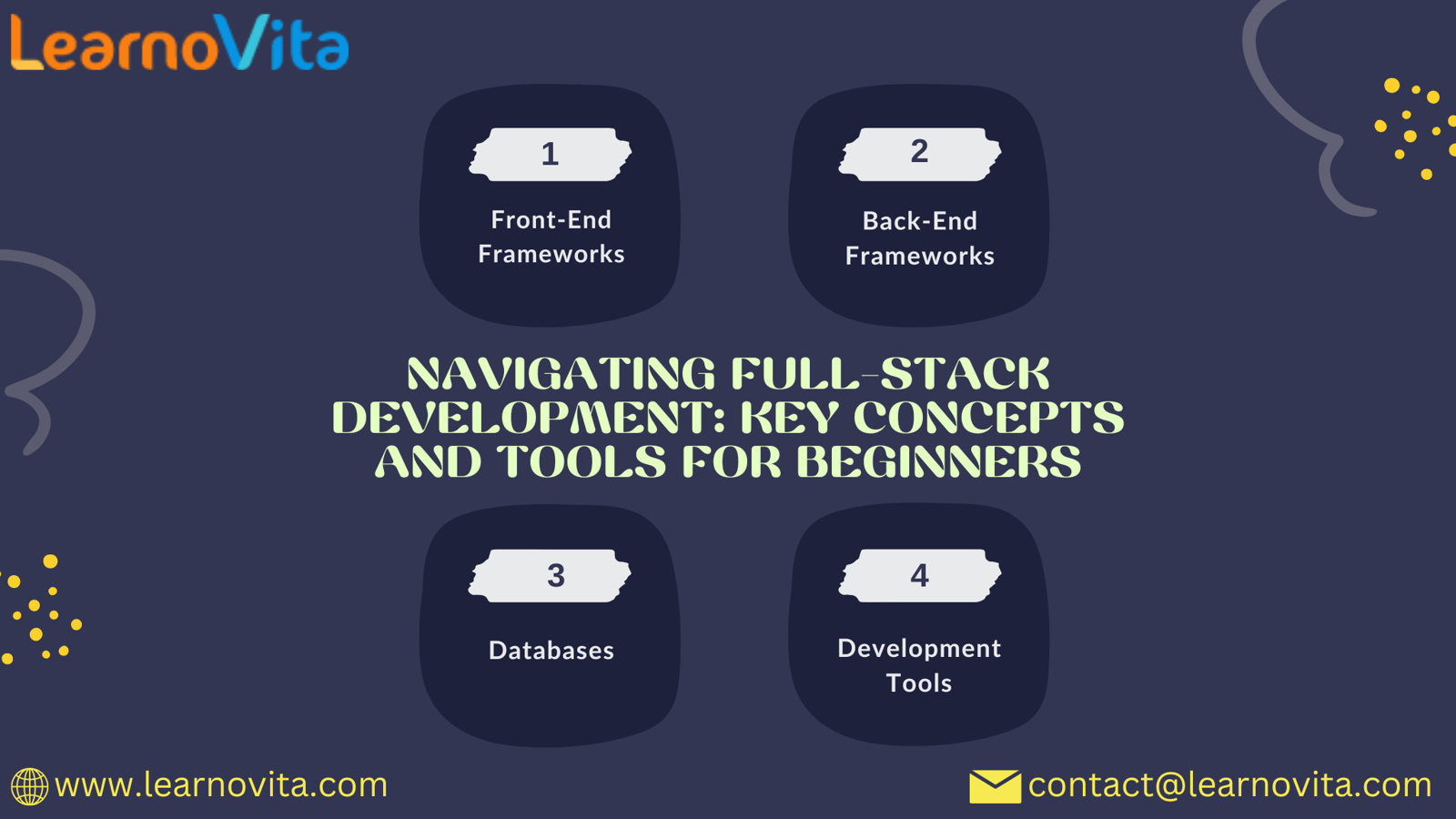
Essential Tools and Frameworks
Front-End Frameworks
React: A JavaScript library created by Facebook for building user interfaces, featuring a component-based architecture that promotes reusable components, ideal for single-page applications (SPAs).
Angular: A robust framework from Google for developing powerful web applications, offering a structured development approach through its templating and dependency injection systems.
Vue.js: A flexible and progressive framework that easily integrates into existing projects, appealing for smaller applications or gradual enhancements.
Back-End Frameworks
Express.js: A minimal yet versatile Node.js web application framework, providing an excellent feature set for web and mobile applications, especially for building RESTful APIs.
Django: A high-level Python web framework designed for rapid development and pragmatic design, with built-in features for authentication, ORM, and an admin panel.
Ruby on Rails: A full-stack framework for Ruby that emphasizes simplicity and productivity, promoting a convention-over-configuration philosophy so developers can concentrate on coding without boilerplate.
Databases
MySQL: A popular open-source relational database management system known for ensuring data integrity and supporting complex queries.
PostgreSQL: An advanced relational database celebrated for its robustness and adherence to SQL standards.
MongoDB: A NoSQL database that stores data in JSON-like documents, suited for managing large volumes of unstructured information.
Development Tools
Code Editors: Tools such as Visual Studio Code, Sublime Text, and Atom offer a user-friendly coding environment.
Package Managers: Tools likenpm (Node Package Manager) and Yarn facilitate efficient dependency management for your projects.
Postman: A widely used tool for testing APIs, simplifying the process of sending requests and analyzing responses during development.
Conclusion
Starting your journey in full-stack development can be both thrilling and daunting. By familiarizing yourself with fundamental concepts—such as front-end and back-end development, version control, and RESTful APIs—you'll lay a solid foundation for your skills. Additionally, getting to know essential tools and frameworks will equip you with the technical know-how to bring your web applications to life. Begin your learning adventure today, and you'll be prepared to face the challenges of full-stack development.




 English
 French
 Spanish
 Portuguese
 Deutsch
 Turkish
 Dutch
Dutch
 Italiano
 Russian
 Romaian
 Portuguese (Brazil)
 Greek
Greek
